I just got back from a week in Pretoria that became a little mini vacation when I met up with some friends that I met in Zambia last December. It reminded me of our Girls Night Out dinners in Austin and was a much needed recharging of batteries.
First, I’ll cover my business in Pretoria because some of it is interesting. The volunteer who was closest to me, but who I wrote left early is sometimes sorely missed. She was on a committee that required her to be in Pretoria frequently so she did my business there for me more often than not. It is not often that I need to go to Pretoria because a lot can be handled using the postal system. However, there are occasions when a trip is necessary and this was one of them.
In December, I visited the eye doctor who informed me that I was right on track with the ageing process, at least with respect to my eyes. I needed less strength for my distance vision, but unfortunately I needed a stronger prescription lens for close work. So he took my favorite spectacles to replace the lenses. I’ve been using my backup pair, but they do not hold my hair in place as nicely as my favorite glasses. I needed to pick up my new glasses. My hair is happy enough once again. I maintain that I can see more clearly than before, but that constant head adjustment with bifocals is irritating. Many of you know exactly what I mean. The rest of you will find out.
Then, I decided that I would take the exam to see if I have what it takes to be a Foreign Service Officer. Although one can study like crazy (we all did), but there is no real way to study for this test. For example, I knew the amendments to the Constitution, but the only question I had referring to the Constitution was about the document that preceded it, the Articles of Confederation. There were easy questions like the area of a rectangle, but then there were things I’d never heard of like the Maghreb. That is only one part of the test and I guess I probably did fair on it as the other parts were easy to me. There were 5 of us taking the test and 3 of us are Peace Corps Volunteers. It seems that PC service is one way of getting a leg up on others taking the test. I guess we will see as there is a long road after taking the test to become and officer and there are other things that interest me in life besides foreign policy.
The other thing that I do when I’m in Pretoria apart from PC business stuff, is try to get things that I can’t easily get in the village. For example, I needed a new version of iTunes so I went to the Mac store to get it. I also am teaching some people in my village to cross-stitch so I found a store there that has a very limited pattern selection, but enough to get folks going here. The art museum is very near the PC office so I usually check to see if there are new exhibits (for R6 it is hard to beat—great selection of Township Art and this time there was a fantastic photo exhibit). And the cinema is always a major attraction. I had wanted to see The King’s Speech, but alas it has not opened here yet. I saw The Tourist with Johnny Depp instead. Ok, but terribly predicable. Still, for an afternoon when I rarely get the opportunity, not bad. Ice Cream, Indian food, and the always-welcome shower rounded out the fun.
I could have come back on Thursday, but instead I called some friends who I met in Zambia last December. They live in Pretoria and we had talked about visiting The Cradle of Humankind the next time I was in town. They had tried to go one Saturday a couple of years ago, but got lost and gave up. As some will attest, lost doesn’t bother me, but I did pick up a little brochure that had a map. Off we went.
The Cradle of Humankind is a World Heritage Site and, in fact, encompasses several sites (15, I think) within a region. There is a site near to me, 2+ hours south, the area where we were is about 1 hour west of Pretoria, and there are some sites to the north. I was curious about why it is called The Cradle of Humankind when the skeleton fossils that I already knew about, Lucy and Ardi specifically, come from a region much more north and east of here (Kenya/Ethiopia). Similarly, the footprints discovered by the Leakey’s are in Tanzania. So why is this area referred to as The Cradle of Humankind?
It turns out that in this region, many fossils have been discovered that are classified as Australopithecus Afarensis or Australopithecus Africanus. Mrs. Ples, the Taung Child, and Little Foot are three that are mentioned. In fact Little Foot is still being excavated from the cave we toured and he hasn’t yet been classified further than Australopithecus. From what we saw, he is more complete than Lucy although possibly not as old. So the area, from an archeological viewpoint, is very well known.
We toured Sterkfontein Caves first. This is an old limestone mine where several of these fossils have been discovered. Some were likely lost due to the mining operation, but it can also be argued that they wouldn’t have been found at all if it weren’t for the mining interests. It is about an hour west of Pretoria and despite GPS coordinates, it is somewhat difficult to find. There are misleading signs to a restaurant as well as all sorts of things in the area being labeled The Cradle. Nevertheless, persistence and asking questions eventually pays off and we managed it this time.
T he tour into the cave takes about an hour and we all enjoyed it. Our tour guide was a great guy who made the stories interesting. He told of miners cutting their way through the stalactites and stalagmites, divers who went down 40 meters and didn’t resurface, and people
In the same region, there is a good museum about evolution in a visitor’s center called Maropeng. It is about another 8 or 10 km from the Caves. At first, I was prepared to think it a waste of money. We walked in and read a couple of wall posters, but that was all that appeared to be there. It turns out that the real interest is underground. It starts with a little boat ride, but that takes you into a museum that is awfully well done. It covers extinctions,
  evolution, resources and effects of each. The depictions are artful and thought provoking. For example, there is a graph of world literacy and the graph is done using pencils for each country. I really liked this. There are several interactive demonstrations (listen to Mr. Dodo and the Wooly Mammoth if you go) and the displays will definitely make you think. One statistic that was quoted was that North America and Europe spend $17B annually on pet food while it
 is estimated that it would take $19B to eradicate world hunger. We also got to put our hands in prints that Nelson Mandela made when the museum was opened. All in all, as long as you manage to get to the basement, this is another spot worth a visit. The views in the area are spectacular, just to top it off.
 There are bigger cats in large enclosures and it seemed that they liked to play with the tourists too. If you stared at one directly, they would sort of charge you. Despite a fence between you and the big cat, you still got a little fright at this.
  There was one leopard who would play with us like this.
 He’d hide in the tall grass and then leap at least as high as I am tall and come at us. It was funny to play back. We’d hide and scrape our shoes in the scree—I’m sure he could see us through the grasses, but we still always gave a little yelp when he came flying.
First, I’ll cover my business in Pretoria because some of it is interesting. The volunteer who was closest to me, but who I wrote left early is sometimes sorely missed. She was on a committee that required her to be in Pretoria frequently so she did my business there for me more often than not. It is not often that I need to go to Pretoria because a lot can be handled using the postal system. However, there are occasions when a trip is necessary and this was one of them.
In December, I visited the eye doctor who informed me that I was right on track with the ageing process, at least with respect to my eyes. I needed less strength for my distance vision, but unfortunately I needed a stronger prescription lens for close work. So he took my favorite spectacles to replace the lenses. I’ve been using my backup pair, but they do not hold my hair in place as nicely as my favorite glasses. I needed to pick up my new glasses. My hair is happy enough once again. I maintain that I can see more clearly than before, but that constant head adjustment with bifocals is irritating. Many of you know exactly what I mean. The rest of you will find out.
Then, I decided that I would take the exam to see if I have what it takes to be a Foreign Service Officer. Although one can study like crazy (we all did), but there is no real way to study for this test. For example, I knew the amendments to the Constitution, but the only question I had referring to the Constitution was about the document that preceded it, the Articles of Confederation. There were easy questions like the area of a rectangle, but then there were things I’d never heard of like the Maghreb. That is only one part of the test and I guess I probably did fair on it as the other parts were easy to me. There were 5 of us taking the test and 3 of us are Peace Corps Volunteers. It seems that PC service is one way of getting a leg up on others taking the test. I guess we will see as there is a long road after taking the test to become and officer and there are other things that interest me in life besides foreign policy.
The other thing that I do when I’m in Pretoria apart from PC business stuff, is try to get things that I can’t easily get in the village. For example, I needed a new version of iTunes so I went to the Mac store to get it. I also am teaching some people in my village to cross-stitch so I found a store there that has a very limited pattern selection, but enough to get folks going here. The art museum is very near the PC office so I usually check to see if there are new exhibits (for R6 it is hard to beat—great selection of Township Art and this time there was a fantastic photo exhibit). And the cinema is always a major attraction. I had wanted to see The King’s Speech, but alas it has not opened here yet. I saw The Tourist with Johnny Depp instead. Ok, but terribly predicable. Still, for an afternoon when I rarely get the opportunity, not bad. Ice Cream, Indian food, and the always-welcome shower rounded out the fun.
I could have come back on Thursday, but instead I called some friends who I met in Zambia last December. They live in Pretoria and we had talked about visiting The Cradle of Humankind the next time I was in town. They had tried to go one Saturday a couple of years ago, but got lost and gave up. As some will attest, lost doesn’t bother me, but I did pick up a little brochure that had a map. Off we went.
The Cradle of Humankind is a World Heritage Site and, in fact, encompasses several sites (15, I think) within a region. There is a site near to me, 2+ hours south, the area where we were is about 1 hour west of Pretoria, and there are some sites to the north. I was curious about why it is called The Cradle of Humankind when the skeleton fossils that I already knew about, Lucy and Ardi specifically, come from a region much more north and east of here (Kenya/Ethiopia). Similarly, the footprints discovered by the Leakey’s are in Tanzania. So why is this area referred to as The Cradle of Humankind?
It turns out that in this region, many fossils have been discovered that are classified as Australopithecus Afarensis or Australopithecus Africanus. Mrs. Ples, the Taung Child, and Little Foot are three that are mentioned. In fact Little Foot is still being excavated from the cave we toured and he hasn’t yet been classified further than Australopithecus. From what we saw, he is more complete than Lucy although possibly not as old. So the area, from an archeological viewpoint, is very well known.
We toured Sterkfontein Caves first. This is an old limestone mine where several of these fossils have been discovered. Some were likely lost due to the mining operation, but it can also be argued that they wouldn’t have been found at all if it weren’t for the mining interests. It is about an hour west of Pretoria and despite GPS coordinates, it is somewhat difficult to find. There are misleading signs to a restaurant as well as all sorts of things in the area being labeled The Cradle. Nevertheless, persistence and asking questions eventually pays off and we managed it this time.
T
 he tour into the cave takes about an hour and we all enjoyed it. Our tour guide was a great guy who made the stories interesting. He told of miners cutting their way through the stalactites and stalagmites, divers who went down 40 meters and didn’t resurface, and people
 and animals falling through the natural cave openings that have since  been fenced. His argument, for example, for man not living in the caves was that fossils of man were found next to fossils of saber-toothed cats and that they couldn’t have coexisted in a cave. Valid enough reasoning, I think. The cave is easy to access, but there are stairs and some tight squeezes if you are a large person. Well worth the visit.
 been fenced. His argument, for example, for man not living in the caves was that fossils of man were found next to fossils of saber-toothed cats and that they couldn’t have coexisted in a cave. Valid enough reasoning, I think. The cave is easy to access, but there are stairs and some tight squeezes if you are a large person. Well worth the visit.
 In the same region, there is a good museum about evolution in a visitor’s center called Maropeng. It is about another 8 or 10 km from the Caves. At first, I was prepared to think it a waste of money. We walked in and read a couple of wall posters, but that was all that appeared to be there. It turns out that the real interest is underground. It starts with a little boat ride, but that takes you into a museum that is awfully well done.
It covers extinctions,  evolution, resources and effects of each. The depictions are artful and thought provoking. For example, there is a graph of world literacy and the graph is done using pencils for each country. I really liked this. There are several interactive demonstrations (listen to Mr. Dodo and the Wooly Mammoth if you go) and the displays will definitely make you think. One statistic that was quoted was that North America and Europe spend $17B annually on pet food while it
 is estimated that it would take $19B to eradicate world hunger. We also got to put our hands in prints that Nelson Mandela made when the museum was opened. All in all, as long as you manage to get to the basement, this is another spot worth a visit. The views in the area are spectacular, just to top it off.
On our way back, only about another 10-minute drive, we stopped at a Lion & Rhino sanctuary. We had lunch in the pub there and then headed over to the crèche to see little kitties. For R30 per person, you can go into the pen to play with the lion cubs.
over to the crèche to see little kitties. For R30 per person, you can go into the pen to play with the lion cubs. The ones we played with were 4-month old white lion cubs. They were frisky in the way that house cats are frisky, but you could definitely see wildness in them. They would stalk people, 
 especially kids, and then pounce. One woman’s skirt was blowing in the wind, which seemed irresistible to the little cub. For us, they would play just like the kittens that they are, but their teeth are big and their claws hurt—a lot. One cat bit my friend on the side and there were definite teeth marks for the rest of the day. Their paws were the size of my hand, just for comparison. It was loads of fun and I’d do it again in a minute, especially if I could hold even smaller cubs.

 especially kids, and then pounce. One woman’s skirt was blowing in the wind, which seemed irresistible to the little cub. For us, they would play just like the kittens that they are, but their teeth are big and their claws hurt—a lot. One cat bit my friend on the side and there were definite teeth marks for the rest of the day. Their paws were the size of my hand, just for comparison. It was loads of fun and I’d do it again in a minute, especially if I could hold even smaller cubs.
 There are bigger cats in large enclosures and it seemed that they liked to play with the tourists too. If you stared at one directly, they would
  There was one leopard who would play with us like this. He’d hide in the tall grass and then leap at least as high as I am tall and come at us. It was funny to play back. We’d hide and scrape our shoes in the scree—I’m sure he could see us through the grasses, but we still always gave a little yelp when he came flying.
One highlight of the afternoon occurred when a handler brought out a cheetah for a bachelor party that was on the premises. I got to pet the cheetah—they are especially soft just behind the ears while everywhere else is a bit coarse.  Cheetahs purr very loudly. We could hear him 15 feet away. I enjoyed it, but I was always conscious of the fact that this purring cat could just eat me if he so chose. Luck was with me that day!
The whole area is a private reserve so you can see all sorts of other animals while driving through the park. One thing that we all wondered about was how these big cats got enough exercise, but we discovered, much to our pleasure that most of the cats are in much, much bigger enclosures and are able to do normal cat things like kill big things to eat. It seemed, at least on the surface that we saw, a pretty good life for the animals and it made them much easier to see up close. We watched some wildebeest frolicking all over the place for quite a while. They were much more fun to watch this way than some of the other times I’ve seen them just standing around with zebras. I enjoyed watching them, and it was definitely a lot easier to see things than in say Kruger Park.
To round out the weekend, we went to a Farmer’s Market that was fantastic. I had the best chai tea that I’ve ever tasted there. We also tried some donut-like things that were filled with cheese or meat. They were good. I bought some souvenirs to send home and another sharp knife for the village. Much thanks to Ilse and Koti for a fantastic weekend. We are planning to meet up again at Easter to hike in the Drakensburgs and I can’t wait!
Try Koti’s Squash recipe:
Get any round squash. We have round green ones that are about the size of a softball. Acorn squash would work too.
Cut them in half and spoon out the seeds.
Fill the spooned out area with creamed corn (just use the stuff from the can).
Sprinkle on top some grated cheese (we used white cheddar, I think).
Then sprinkle on some salt, pepper, and paprika.
Bake in the oven until the squash part is soft and the cheese is melted and browned, 350 F for 30 minutes.
Serve warm. I’ve made them twice now since I got back to the village.
Cheetahs purr very loudly. We could hear him 15 feet away. I enjoyed it, but I was always conscious of the fact that this purring cat could just eat me if he so chose. Luck was with me that day!The whole area is a private reserve so you can see all sorts of other animals while driving through the park. One thing that we all wondered about was how these big cats got enough exercise, but we discovered, much to our pleasure that most of the cats are in much, much bigger enclosures and are able to do normal cat things like kill big things to eat. It seemed, at least on the surface that we saw, a pretty good life for the animals and it made them much easier to see up close. We watched some wildebeest frolicking all over the place for quite a while. They were much more fun to watch this way than some of the other times I’ve seen them just standing around with zebras. I enjoyed watching them, and it was definitely a lot easier to see things than in say Kruger Park.
To round out the weekend, we went to a Farmer’s Market that was fantastic. I had the best chai tea that I’ve ever tasted there. We also tried some donut-like things that were filled with cheese or meat. They were good. I bought some souvenirs to send home and another sharp knife for the village. Much thanks to Ilse and Koti for a fantastic weekend. We are planning to meet up again at Easter to hike in the Drakensburgs and I can’t wait!
Try Koti’s Squash recipe:
Get any round squash. We have round green ones that are about the size of a softball. Acorn squash would work too.
Cut them in half and spoon out the seeds.
Fill the spooned out area with creamed corn (just use the stuff from the can).
Sprinkle on top some grated cheese (we used white cheddar, I think).
Then sprinkle on some salt, pepper, and paprika.
Bake in the oven until the squash part is soft and the cheese is melted and browned, 350 F for 30 minutes.
Serve warm. I’ve made them twice now since I got back to the village.


 plenty of crocodile infested rivers. I declined. Now though, the stretch of river just below Victoria Falls is full of white water and most crocodiles do not live through it. Hippos and other water dangers are also farther downstream. So off I went.
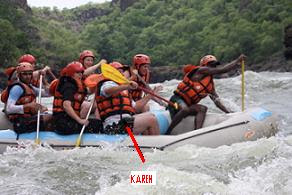 skills over two separate water falls that were probably 30 feet high and at least one of them was also long. Camping on the riverbank is much like other rivers I’ve paddled with sandy camps and plenty of firewood and the food was fantastic. Unlike other rivers, the water was warm and we did see crocodiles. Pitting myself against white water and physical exertion was exactly what I needed to put my mind back in a better frame after report cards.


 of fireworks that you could buy at a roadside stand in Texas provided you are outside the city limits. It really was beautiful. I was thankful that there had been a lot of rain earlier in the day.


 funeral. During this week, there are women from the village who come to the house to stay with the family, pray with them, sing with them, etc. There are informal prayer services several times during the week where the ancestors are called upon to look after the soul of the newly deceased.
 a baked bean salad, and a butternut squash or pumpkin salad. That is the minimum for salads.
 They also dig the grave and slaughter the cows or sheep. They collect the firewood for the women and are generally helpful. Women slaughter the chickens. The men cook all the meat for the celebrations. Again, it takes all night.

 Sonja's girls and my boys

 in the aisles and anywhere else you can imagine—for the whole trip. If it is 16 hours, then there is 16 hours of singing. The buses are always overcrowded and you will not be in the lap of luxury. If you are going with older kids, they will expect a stereo system on the bus and will play music at really, really high volume. They will sing and dance along with the stereo. I used earplugs and my ears were still muffling sound more than 8 hours after I got off the bus. You must shout to be heard even by the person sitting immediately on top of you and you will be hoarse by the time you get where you are going. It is not restful. Third, in SA the gender roles are pretty strongly defined. Men are in charge of barbecues (they call it braai), some cooking (i.e., they will fry eggs), and making sure there is beer. The women do most everything else. There are exceptions, of course, but this is the general trend. It can be frustrating. But, if you are prepared, you can have a fantastic time.
 up in Pennsylvania. Her two schools are huge compared to mine and two of our principals are very good friends. She has invited me to go on several of her school trips and I’ve always enjoyed myself. Her teachers are a lot of fun and I enjoy learning different things with them. This time it was a sports trip to Ottosdal about 2 hours away on a Saturday.

 buses, alcohol, more alcohol…I’m pretty sure we all wondered what it was exactly that we had just gotten ourselves into. This year, the trip wasn’t quite as exciting (thank goodness!). The boys lost both soccer matches and the girls won both netball matches.
 NET BALL CHAMPS
 bus officially carried 60. Mr. Segatle and the sports committee who organized the trip made the right call and got another little mini-bus to carry all the kids. The bus driver was not accustomed to driving in the big city so several times I thought we were going to die. He would just stop in the middle of the motorway in Joburg while he tried to change lanes.
 It was a first and I hope it will continue in this vein for future kids’ trips. Maybe that will be one of my Peace Corps accomplishments along with banning the beatings at the middle school!


 A few days later, Jeff found a pair of small binoculars for R60 in a shop. He came running up to me to see if I’d buy them for him, which I did. He looked at EVERYTHING through those binoculars for the rest of the trip.
 behaving well so I said yes and that I’d see them later at the hotel. The rest of us went off to the harbor to take a little cruise and eat at a burger place. There was a big soccer match on that everyone wanted to see so they watched that.

