Friday, October 1, 2010

Teacher's Strike and Road Trips

Sept 30, 2010

Teacher’s Strike and Road Trips

We started out the third term at school with a pending teacher’s strike. We were at school for about 3 weeks and during that time it seemed that the major topic of discussion was if the teachers would strike or not. It seemed inevitable to me that they would because the main thing I heard was that they all deserved a pay increase because other sectors had received one. I didn’t hear anything about whether or not the work they did was improving or if the kids were better off now than they had been a year or two ago. Just that they deserved a pay increase because others had gotten one. Sure enough, the strike came and work ground to a halt.

I should say here that the Peace Corps wants us to remain uninvolved and say nothing despite the fact that we are working in the schools so my comments on this are my own opinions and have nothing to do with Peace Corps policy or the US government’s policies.

The terms are each usually about 50 days long. There are 4 school terms per year. This year, our second term was cut short because of the World Cup that was held in June/July. The government didn’t want extra transport on the roads during the games so that they could better facilitate the traffic to the venues. On the whole, I agree with this because SA traffic is horrendous at best. On the downside, there were no games within several hundred kilometers of where a lot of kids go to school and they were adversely affected by not being in school. Couple this now with a strike that wipes out the third term and kids have learned very little this year.

To be fair to the teachers, the government officials earn about R700, 000 per year. They are given a very generous housing allowance and a car allowance. I’ve heard them say “they must drive a Mercedes Benz because their position demands they have that type of status car”. I have yet to hear anyone suggest something like a company car to be driven on the rare occasions when they have to ferry someone who demands to be driven in a Mercedes. There is a fair amount of nepotism and in fact it appears that man can be and are corrupted by power at some point.

In contrast, the often better educated teachers with more experience can earn as little as R150, 000 per year, receive a R600 housing allowance per month, and have no car allowance. This also applies to nurses and most public officials. They often cannot afford to buy a house and sometimes live in poor conditions. Most of the teachers do a fantastic job, but there are many that need to be culled from the herd because of absenteeism, alcoholism, and abuse. Those give the majority a bad name. On strike, they were destroying property and injuring those who chose to go to school and teach.

The disparity provides perfect conditions for a strike. The unions do not solve the problems within their ranks and the government officials do not admit that what they are providing for themselves is unjust. In the end, the kids are not learning what they need to learn to succeed. It is a shame. Our kids went to school at about a 50% rate during this time…I went to one or the other of our schools everyday and did all sorts of things from painting the schools to playing math games. During this time is the first time in 14 months that I thought of going to Canada (it is hot in Texas this time of year!) and telling them all to call me when they get their shit together. I hate seeing the kids suffer because of grownups and their power struggles.

Once we did get back to school, it was time for me to get my mid-service dental and medical checkups. I went to the most advanced dental clinic to have my teeth cleaned. There was a machine there that would image your mouth for a crown, cap, veneers, etc. and it would make a mould that would be ready in an hour. It was really cool to see. The dental hygienist who cleaned my teeth really did a thorough job of it and it felt good to get the gunk off. I’ve got a generally clean bill of health and am glad that part is done. I don’t think anyone likes medical work except the doctors.

At school, I’ve been on three school road trips in 2 weeks. The volunteer before me said it best. I love her phrasing: “I think most Americans would fold on a South African road trip with the kids.” First of all, in 14 months I have yet to be on a school trip where the adults were not all drinking alcohol first thing in the morning on the bus—kids or no kids. It is irksome and dangerous and many volunteers can attest to the fact that the bus drivers will also indulge when they are waiting for the kids to show back up, usually all day. Second, the primary school kids will sing at the top of their lungs standing in the aisles and anywhere else you can imagine—for the whole trip. If it is 16 hours, then there is 16 hours of singing. The buses are always overcrowded and you will not be in the lap of luxury. If you are going with older kids, they will expect a stereo system on the bus and will play music at really, really high volume. They will sing and dance along with the stereo. I used earplugs and my ears were still muffling sound more than 8 hours after I got off the bus. You must shout to be heard even by the person sitting immediately on top of you and you will be hoarse by the time you get where you are going. It is not restful. Third, in SA the gender roles are pretty strongly defined. Men are in charge of barbecues (they call it braai), some cooking (i.e., they will fry eggs), and making sure there is beer. The women do most everything else. There are exceptions, of course, but this is the general trend. It can be frustrating. But, if you are prepared, you can have a fantastic time.

My nearest volunteer is Sonja. She’s a lovely young lady and we share an engineering background as well as work in the semiconductor industry. She and I both lived in Austin prior to joining the Peace Corps and we both grew up in Pennsylvania. Her two schools are huge compared to mine and two of our principals are very good friends. She has invited me to go on several of her school trips and I’ve always enjoyed myself. Her teachers are a lot of fun and I enjoy learning different things with them. This time it was a sports trip to Ottosdal about 2 hours away on a Saturday.

Last year, this trip was Sonja’s introduction to life in the village and she had the best stories hands down when we all rejoined to talk about our experiences—drunk bus drivers, trips to the hospital for injuries, a principal who was freaked out by the hospital, extremely overcrowded


buses, alcohol, more alcohol…I’m pretty sure we all wondered what it was exactly that we had just gotten ourselves into. This year, the trip wasn’t quite as exciting (thank goodness!). The boys lost both soccer matches and the girls won both netball matches. One note about the village matches…soccer is played often with no shoes on rough ground. The “grass” is usually just brown dirt with nettles, stickers, and glass about so it is amazing that there aren’t more injuries. Kids don’t always have a pair of shoes…


NET BALL CHAMPS

I can say that every new place we visit, Sonja and I are the unusual ones in the crowd and generate a lot of questions and curious looks. This trip was no exception and by the end of the day, I had three new marriage proposals. Usually I say my conditions are that I won’t do your laundry, if I cook you clean and vice versa, and I am not having your babies for any reason. That generally is enough to persuade men that I’m not the woman of their dreams. By now, most of the teachers we know get a good laugh out of us. The new people get let down easily and everyone is happy.

The second trip was with my primary school to Gold Reef City in Johannesburg. Joburg is about 5 hours away. These kids are all from grades 1-6 so the little ones are 6 or 7 and the bigger ones are 10 or 11. We had 85 people and I think the
bus officially carried 60. Mr. Segatle and the sports committee who organized the trip made the right call and got another little mini-bus to carry all the kids. The bus driver was not accustomed to driving in the big city so several times I thought we were going to die. He would just stop in the middle of the motorway in Joburg while he tried to change lanes.

One huge plus was that after a year of listening to me gripe about alcohol on school trips and being a responsible role model, the principal got the adults together and banned alcohol. I didn’t know if it would work, but it did and I think the trip was much better without it. The bus drivers were also told of the rule and they didn’t run off and buy their beer while we were at the amusement park. It was a first and I hope it will continue in this vein for future kids’ trips. Maybe that will be one of my Peace Corps accomplishments along with banning the beatings at the middle school!

We also went to the planetarium. The guy operating the show started out asking everyone if they had looked at the sky and talked about Venus, Mars, and Jupiter being in the sky right now. He handed out copies of a star chart and showed them how to use it and then told the kids to look for Venus that very evening right after the sun went down. The minute he turned out the lights, there were loud oohs and ahhs as the show began. The kids learned about the planets, but all 6 of us adults had been up cooking the breakfast that we took with us since 2:30am. (We left the school at 4am.) Naturally, we all dozed from Jupiter to Neptune and laughed about it afterwards.

We then took the kids to Gold Reef City. It is an amusement park that is built around the old gold mines upon which Johannesburg was founded. The tour of the mine had them all donning hard hats, going down the mine elevator to a depth of 225 meters, and then touring the mine tunnels. It was fun, but I don’t think I could be a miner. It was and still is a hard job. In the mine elevator, the kids were all singing Shosholoza that is a song about a steam trains that is used for marches, football matches, and sort of motivational. It is a bit like The Little Engine That Could for inspiration. The kids all rode the rides until we left. It was getting dark as we pulled out of the parking lot, handed them KFC, and braved the big motorway again. We got home after midnight and again the kids stood, danced, and sang the whole way. I was exhausted.
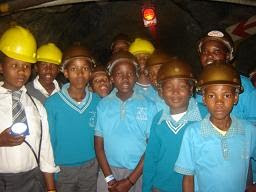
The third trip was with my middle school to Durban on the coast, some 16 hours away. The kids here are all in grades 7-9 so they are aged 12-20. Many of them had never even been out of the village, not even to some of the smaller towns around here, 60 km away. Durban is on the coast and is the center of the Indian population in South Africa. It is the place where Mahatma Gandhi made his first forays into passive and non-violent resistance. Although the kids didn’t sing their own songs the entire way, they did make good use of the stereo system on the bus which was cranked up to concert volume the entire 16 hours—yes, even at night. I used earplugs and my hearing was still muffled 8 hours after I got off the bus. I shudder to think of what will happen when I’m 70.

There were 38 kids, the principal and me. I thought we needed another adult, but when I raised the issue I heard that it was 20 kids each to mind, which is far less than 1 classroom full. Still, I had a sneaking suspicion that I would be minding 38 kids and 1 principal. Turns out I was right. I did ban the principal from drinking alcohol in front of the kids and at least we didn’t have that problem.

Several groups of friends from Austin & Canada sponsored kids for this trip and I can’t tell you all the ways in which the kids’ lives have been changed. One example is Jeff, an orphan in grade 7. We were walking along the beach when they asked questions about things that were far off at sea. I had my binoculars that I showed them how to use to see those things. They noticed oil tankers, cargo ships, oilrigs, buoys, and closer in some surfers. One kid was so mesmerized by what he was seeing that he failed to notice the waves coming in and got his tennis shoes and trousers wet up to the knees. A few days later, Jeff found a pair of small binoculars for R60 in a shop. He came running up to me to see if I’d buy them for him, which I did. He looked at EVERYTHING through those binoculars for the rest of the trip.

The grade 9 boys, some of whom I’ve been hounding to get to school on time and show some responsibility, asked to go off one afternoon to look at other stuff instead of going on the boat. There were 5 of them and they were all really behaving well so I said yes and that I’d see them later at the hotel. The rest of us went off to the harbor to take a little cruise and eat at a burger place. There was a big soccer match on that everyone wanted to see so they watched that.

We got back to the hotel later than I wanted so I was a little worried what my older kids had gotten themselves into while we were gone. When I got back, they were all there waiting and when I asked them how their afternoon was, I was told, “They saw prostitutes, but didn’t touch them as they didn’t want any diseases”. I had already had a talk with all the kids about boys being in girls’ rooms and vice versa saying that I was sure they’d keep the door open when someone was in there. I also said I was not going to explain it to their parents when they were caught pregnant from the Durban trip, but after the snickering died down, they all knew exactly what I was talking about.

The principal and I had several disagreements, all mainly centered on responsibility. After I refused to hold the room keys (including the principal’s), I said that they all looked after all sorts of things at home. Many were orphans and/or took care of younger siblings at home. They are good kids and they can keep track of their stuff. I asked him if they weren’t going to learn this now while they are this age, when are they supposed to learn it? In the end, we didn’t have any lost keys, any lost wallets, or any pregnancies that I know of. The kids were great.

We did have forgotten toothbrushes, one case of seasickness, a discussion about why toy guns aren’t a good idea, a strained muscle, a headache, countless requests for R5 to buy X or to play video games, one kid who needed different food because “hamburgers make me vomit”, kids who were cold, kids who needed an apple or an ice cream to tide them over, a principal who was bored/tired/hungry etc. on the bus (and who got busted for smoking in the back of the bus)…you name it. We had all those normal road trip things. Mainly I doled out hugs, a lap to sleep on, R5 for whatever, explanations from evolution to AIDS and sex, and anything else you can imagine. It was great fun, but I’m so glad to be home!

The kids had the time of their lives and THANKS to everyone at home who helped me out and sent a kid or three! You are my heroes.

Monday, July 26, 2010

Spent One Year Anniversary in Madagascar!!!!


July 18, 2010

Madagascar!

This Friday I will have been in South Africa for 1 year. I can’t say that I miss America, but I do miss friends. My good friend, Lisa, was asked if I was planning to visit home during my two years here. I can imagine her answer, probably somewhat chagrinned, when she said that as long as there was some corner of Africa as yet unexplored, then I wouldn’t be home. So I can now add Madagascar to the areas that I’ve partially explored. I must say that two weeks there is not nearly long enough for me.

A year ago, my friend, Dennis, was transferred to Madagascar to work on a startup mining operation there. Needless to say, I started planning my trip just about then. Katherine and his wife, Mary, met us there and we spent a great time looking for lemurs, hiking in the Tsingy, and seeing what the markets had to offer. Seeing Katherine, Dennis, and Mary was definitely the highlight for me, but the lemurs were a close second.

This island nation is the 4th largest island in the world (Greenland, Baffin Island, and Borneo for Greg F.). It is definitely poorer than South Africa and last year’s political coup d’état didn’t help matters. On the island, the change in governments (new one isn’t recognized and old president is in exile in South Africa) is called the crisis and most of the people who we spoke to about it feel that life for all but the very wealthy is a lot worse. I’d say that although the island is rich in its ability to grow just about anything, the infrastructure doesn’t support getting the produce to the people and hence the people are not receiving adequate nutrition. The markets are beautiful in their abundance, but I would guess that the people in the villages are better fed than the ones in the cities. The fruit was so good that I think it might have inspired me to go on an island tour to see which one has the best fruits.

The capitol, Antananarivo, is built on all the high points. The low-lying areas are used as rice paddies. Rice alternates with clay brick making in one of the oddest crop rotations I’ve ever heard of. In the rainy areas in the south, the people grow 3 rice crops each year. This has got to be one of the most backbreaking jobs I’ve ever seen. Although I’m not a big fan of rice, I have a new appreciation for it from the women who do it all by hand in this nation. Although government buildings and palaces look relatively modern, the majority of the buildings looked to me like something right out of Pirates of the Caribbean, the Disney ride version. The streets are narrow and lined with markets just about everywhere we went. I walked around town the first day I was there and saw all sorts of life. Very interesting.

Madagascar is very difficult to navigate. The roads that exist are full of what they call ostrich holes, but I’d call them elephant holes. We hired drivers to take us around and of all the roads there was only one that I’d call mostly good. Otherwise, it can take 5 hours to go 90 km. I’m pretty sure most of the west coast is not road at all, but washed out river beds and I heard that they are not navigable during the rainy season. Katherine’s father thought we should just rent a car and go ourselves and I’m flattered that he thought we could. I’m not sure how the guys knew when to turn and getting on and off the river taxis was just a little more exciting than I think I want to attempt.

We did have an excellent opportunity to discuss matters with 4 of the current government ministers on a flight that we took in country. We blew it when we discovered just how high up they were after we landed and Mary happened to get off the plane in the middle of them. The entourage meeting them had all sorts of press coverage—I should have guessed at their importance when they were the only largish people we saw on the entire island. Surely, they are men with plenty and the government is supporting them just fine. It would have been great to discuss the road situation and the accessibility to tourism with them…our one chance on the whole trip to make a difference…rats.

On the west side of the island, Kirindy Forest showed us our first taste of lemurs and chameleons. The island separated from Africa and Asia something like 165 million years ago and the flora and fauna have been evolving in isolation ever since. Something like all the mammals, 90% of the reptiles, 75% of the flora, and 50% of the birds do not exist anywhere else on earth. We started our visit with a night walk and I think we were all amazed at our guide’s ability to spot inch long chameleons and mouse sized lemurs at night. We followed with a day walk and were continually surprised by the lemurs and their one mammalian predator, the fossa.

There are 100 or so species of lemurs and I think we saw maybe 15-20 of them in the two weeks we were there. The smallest is the size of a mouse and it scurries like a mouse as well. It is nocturnal and would fit in your fist pretty easily. The largest is diurnal and is about 3 feet tall with no tail. It lives in the rain forests of the highlands. There are many, many that are about the size of a cat so finding them in the forests is tough, but once you realize what they eat and about the height to look for them, spotting them becomes a bit easier. I enjoyed going out early in the mornings and walking through the forests quietly. In that way, I saw plenty of guys just waking up and getting their breakfast. The guides are amazing in their ability to find them and they are intrepid in their task of showing them to you. (You must hire a guide in the National Parks.)

The west coast has deciduous forests that were mostly barren when we visited during winter/dry season. The southern coast has spiny forests that are being clear-cut to create sisal plantations for the world’s rising demand for green packaging. And the east coast has the rain forests of the highlands. We decided that it would be tough to live in this cold, damp climate most of the time. Otherwise, despite being winter, it was hot and dry. Of course, each ecosystem has different lemurs, chameleons, frogs, birds, and trees that create a unique environment. Even the beach on the southern coast had fabulous tide pools that created within me a sense that I was killing something with every step I took.

We managed to get up to Bemaraha which is where the stone forests or Tsingy are located. National Geographic did a piece on this ecosystem in November 2009 and it is listed as a World Heritage Site. We hiked through this unique stone forest for an afternoon. Millions of years ago, a sea in which coral reefs formed covered this area. Through plate tectonics, the area rose above sea level and then the limestone formations have been eroded to form some unbelievable rock formations. Grand Tsingy has peaks 70 meters high interspersed with caves and tunnels. It is ideal for hiking especially since the National Park Service has created some trails with some climbing aids to get through the rough spots. This was definitely one the highlights of our trip.


Another spot to visit on the west coast is the Avenue des Baobabs. There are 6 species of Baobab tree that grow on Madagascar. In one area, they cover the area like a little Baobab forest and I’ve never seen anything like it. The other Baobabs that I have seen were largely on their own in Botswana. There is even a dwarf Baobab that is sold potted. I wish it were something that could be imported to Texas, as I’d definitely have one. The guides managed to get you there just at sundown so it is a beautiful site and getting out of the car after a 10 hour day of driving was welcome.

The national animal is the Ring Tailed Lemur—and if a raccoon had a long tail and was a primate, it would be a Ring Tailed Lemur. We saw them in Berenty on the south coast in the spiny forest. I must say that these guys are bold as brass. They will steal your breakfast if you aren’t vigilant. They will grab your hand to get your tangerine peel if you aren’t looking. They will gang up on you to intimidate you into handing over your banana peel. And they will get into the lemur proof trashcans. Nevertheless, you will laugh and once you know that they are not aggressive, you will make Dennis hold them off while you eat your breakfast. He says they feel like lean cats and I can say that their “hands” are soft and leathery even if they didn’t get my tangerine peel. I could watch lemurs all day.

One of the biggest lemurs is called a Sifaka. This species was the only type of lemur that we saw “walk” on two legs. The back legs are longer than the front so they had a little sort of dance to move across from one area to another. It was funny to watch them. Sifaka and Ring Tailed Lemurs both live in the spiny forest and no one knows exactly how they manage to jump onto all the prickly things in this forest without getting hurt. It is hard to imagine anything spikier than the things in this forest, but these lemurs both go from limb to limb as if they don’t feel a thing.


We visited a school on the south side as well as the sisal plantation. In the village, Katherine drew a crowd with the wheelchair. She let some of the villagers try it the chair while she gave directions from a bench. Some of the men were so impressed with her that she snagged a marriage proposal and the fellow was even willing to give up ALL his other wives if she would just stay. She said how honored she was, but that she had to get back to Canada shortly.

Some of the guys we were hiking with in the forests went out of their way to gather things to show us. In this manner, we saw snakes, owls, chameleons, lemurs, and the odd cockroach. These are the kinds of bugs that you see in museums. It is hard not to offend the presenter of a cockroach, but the natural girlish reaction is a little girly scream—same reaction as a snake. Who knew?

Nearly all the guides were game to take the wheelchair places that they had never taken one before, but I thought that Katherine should have let them all try it BEFORE the hikes instead of after. She makes it look easy, but I can tell you from experience that it isn’t. As we were leaving one place, the woman told Kath that she was amazing, but in her Malagasy accent it sounded like she said that Katherine was amusing. Needless to say, Mary and I jumped all over it as Katherine has amused people the world over. In fact, sometimes life would be a little easier if she wasn’t so amazing/amusing.

The smaller lemurs are prey for owls and snakes, but the fossa is the only mammalian predator that the lemur has. I’ve heard it said that the fossa is hard to find in the wild, but in fact, it wasn’t hard for us. We saw it at Kirindy Forest on our first day out. I had washed out some trousers and a shirt. As some of you know, I hate to do laundry. I probably won’t complain about it ever again when I have a washing machine, but it is done by hand in Madagascar and in South Africa and I did it by hand at Kirindy. I hung my shirt and trousers outside on the line to dry. After all-night flights and then staying up all night talking, then driving most of the day, naps were in order. I am not a good napper—I don’t do it unless I’m sick generally, so I got up after a bit and went to watch the guys play bocce. The fossa crawled into our cabin through the open door and woke Mary up by snuffling around my tennis shoes. She shooed it out and later that evening we went on our night walk. I didn’t have my flashlight on the way back so I helped Katherine into the cabin up the steps and then headed to bed myself. The next morning, I discovered my trousers ripped to shreds and eaten by the fossa. They were beyond repair and THEY WERE CLEAN! Mary had noticed them the night before when we came back from our walk, but didn’t realize the import. I was unhappy at this turn of events, but alas, what can you do when the fossa eats 1/3 of your wardrobe. Luckily my shirt was unharmed and Katherine had extra trousers.

The rain forests of the highlands are pretty fabulous for vegetation, chameleons, and frogs. I kept thinking of my friend, Susan V., as she would have loved the chameleons and the frogs. The guide here, Levi, would go around saying things like “I’ll just find you another frog” and then he would. These guys are the size of your pinky nail and just like what you see in museums. He’d find chameleons and then catch grasshoppers and place them at least a body length away from the chameleon so we could see how long their tongues were…as long as their entire body including the tail. The smallest chameleon is about an inch long and the largest is about 20 inches long. They can move their eyes 180 degrees…amazing and they change color too. The largest lemur, the Indri, lives here in the rain forest and the mines for nickel and titanium are in this area. We went to Andasibe and hiked off trail to find the brown and wooly lemurs. I could have done without the leeches, but the hikes were fabulous. Orchids grow wild on trees all over Madagascar, but the rain forests had more than the other areas.

We figured out at least two super business ideas. One is to fly tourists to Bemaraha in a floatplane that bypasses a strenuous drive through dry riverbeds and would allow tourism in both wet and dry seasons. The other is in Tana at the craft market. If one were to set up a shipping stall that took credit cards, a fortune could be made from tourists who can’t get large items home without shipping them.

All in all, Madagascar is beautiful. The countryside is idyllic, but on closer inspection you can see how poor it is. Work is all done by hand, water is hauled from rivers and I assume boiled, trees are cut down to create charcoal to heat and cook with, transportation and infrastructure is pretty much non-existent and the people are incredibly charming and nice. The roadside markets are lush and the food is fabulous. Two weeks is not nearly long enough to visit and I wish I had more time there.

Conservation is facing an uphill battle, as it is difficult to explain why the forests should be preserved when sisal and charcoal are such important parts of the economy and represent food and warmth. Mining will help create jobs, but again at the cost of the forests. Although the companies try to reforest as much as they can, pipelines need some clear-cutting to exist. The current government isn’t doing anything to repair the roads and the one good road will deteriorate rapidly with the lack of drainage and the heavy truck traffic. Since the government isn’t recognized, foreign aid has ceased to come into the country. The people, when asked, are just waiting and hoping that the old president will come back. Tourism is recovering from the 2009 coup, but is not yet at the 2008 levels. In 2008, you had to book 1-2 years ahead of time. We managed to book about 2 days ahead of time. Time will heal some of the damage, but in the meantime, this island cannot feed itself and there isn’t enough money to import what is necessary. Peace Corps has just re-established the program in Madagascar and I must say it is a great opportunity to live for 2 years…in that time, I just might see all the things that I wanted to see.

(There are more pictures on Facebook so go there to the album if you want to see even more!)

Thursday, July 1, 2010

Happy Father's Day!!!!!!

June 20, 2010

I can’t believe it has been nearly 2 months since I last wrote. I wish I were more like another volunteer here who manages to write at least 3 or 4 times a month, sometimes more. I know she is just as busy as I am, but she is really dedicated about writing in her blog and letting her friends and family at home what is happening with her. One day, I’ll be more like that or you all will just have to wait for the book.

The school term has flown by. We are in the middle of the winter break here. The school system shut down a couple of weeks early in order to accommodate the World Cup games. The authorities want fewer cars on the road during the games, but I’m not sure how much less traffic this creates in the urban areas. In the rural areas, it doesn’t change anything since we really have few cars anyway. The conflicts on the road come from donkeys, goats, sheep, potholes, and drunks both walking and driving. Nevertheless, school is out. Pics of kids from last day of school.


Our schools competed in an area-wide choir competition at the beginning of May. The primary schools’ competition was held on the Saturday. Our Grade 1-3 choir placed second, but the older Grade 4-6 kids didn’t do as well. I took a

cross-stitch project with me because there was a lot of sitting. The number of people who thought cross-stitch should be taught was huge, but I haven’t been able to find even DMC floss or Aida cloth anywhere locally. The middle school competition was held on Sunday. They also placed second for each of the songs they sang. For the middle school, this entitled them to move on to the larger area provincial competition that was held the following weekend. Again, they placed second. They sang 4 songs, but there was another local school that sang so well that I knew they would be hard to beat.


An odd thing happens in South Africa. The funding year for the schools is disjointed from the funding year of the government who is in charge of the schools. So for a complete term, nearly, the schools have no funds. This means they cannot buy paper, ink, electricity (they beg to keep the power on from the large power company), salaries are foregone, etc. It is a tense time for the principals who have to manage this problem. Some are better at budgeting than others, but all are affected to some degree by the problem.

Consequently, I convinced my supervisor to take off one Friday afternoon and go to town to see Iron Man 2. We corralled his wife into joining us and just escaped for an afternoon. Going to the movies is not as easy as it once was—it is several hours away, but worth it if you can get there. There are giraffes and rhinos along the way. Any anytime someone goes to town, especially with a car as opposed to a taxi, there are errands to be run and things to be purchased. We had a great time and laughing/losing oneself in a movie is a great way to forget the stress of work occasionally.

Fall here in South Africa has been abrupt…it went from really hot to really cold pretty quickly. During the summer, although I complained about the heat, there were days when it was cold and rainy and I used my light jacket. Now, I wear my jackets, hat, and gloves most of the time. It can be warm if you are outside sitting in the sun with no wind, but that isn’t all that often. I now completely understand about stocking caps, warm socks, flannel pajamas, and a hot water bottle…all that works wonders if you also have two blankets. South Africa continues to be a country of extremes.

The leaves on the trees have turned, the flamingoes in the nearby saltpans have migrated, the sunbirds are less frequent, but the starlings, the canaries, and the crows stick around. I’ve also seen some of the birds of prey around still too. The ants have retreated, but I still see the yellow mongoose families around a lot. It is fun to watch them running around marking their territory.

Oddly, we’ve got baby lambs at this time of year. I thought that babies naturally were born in the spring when food is plentiful. I’m not sure how I thought this happened—I guess I never gave it much thought really. When I asked Kgosi about it, he said it was an accident that mostly occurs because there is no fence. So I guess you can’t keep rams away from ewes when they are determined no matter what season it is.

Speaking of birthdays, a bunch of the kids who hang with me have birthdays in June. They are all turning 12 years old so we had a birthday party. The boys were talking about it for weeks. I went to Mafikeng and got balloons, and some presents. (Their advice to me was “don’t forget the presents”). I also bought the stuff to make a cake and sandwiches. So in the end, we had tuna and peanut butter and jelly sandwiches, chips and soda, and a French vanilla cake with chocolate butter cream frosting—blue candles. I bought a tablet and gel pens, a soccer ball, some ear buds, a key holder and flashlight, and some candy. I also downloaded Tetris and Pacman onto my iPod. Sonja and I saw some fake teeth that were made from gum. I thought they were hideous, but Sonja was dead on when she said the boys would love them. I bought them and she was completely right. The boys morphed into some kind of hunchback character when they wore those teeth. It was funny. Kathy sent along another soccer ball and Sonja provided some more candy. All in all, it was a great party. One of the boys has his birthday in October and another girl in September so I imagine the next party will be then. I’ve already been told that a watch would be a great gift.

Some friends from Austin sent me a great gift box of teas, mouse pads, and chocolate chips. My friend, Anita, works at The Coffee Bean & Tea Leaf so she asked me if I could take some pictures of us drinking the teas. She sent me Apricot tea and Pomegranate Blueberry tea—these come in fantastic tins. I took the teas to the primary school on the last day of school for a little tea party along with some chocolate chip cookies. Talk about the best tea party in South Africa…first smelling and admiring the most beautiful tea bags in the world. We get a

generic black tea here so flavored teas are a great treat. Then tasting the teas…they are both so wonderful that there is no way to choose just one. Luckily, we all discovered that you might use these tea bags at least 3 times with no problem so there was a lot of tea consumed. And now as I continue to drink tea, I am looking forward to using these beautiful tins to hold all manner of items. We use everything here and something as beautiful as these tins will go a long way. Oddly, other volunteer friends who have been here also prize these tins, even over the tea they contain. I love the tea first, but the tins will come in handy!


One funny thing from the tea party, when I was asked how many cookies they each could take, I replied, “you may take as many as you like”. This created a huge uproar…”NO”, everyone cried. I was told that I “must say how many each could have otherwise people wouldn’t leave any for others.” The thing that is ironic here is that everyone shares everything. If someone is eating an orange and I walk by, I will be given half. If there is one computer and 5 kids, they take turns and find a game that 4 of them can play at once. If there is a shirt that you admire, you might find it in your closet. So if you had a handful of cookies and someone wanted some, you’d hand them over and never even complain. You’d think three-dozen cookies would easily cover 13 people, but they go fast. As far as I know, everyone got some.

I’m now getting ready to leave for two weeks in Madagascar. I’ll take the camera, but more importantly Katherine is meeting me there so she’ll take all the good pictures. I told Dennis when I was coming picking dates where my leave corresponded to his leave and then called Katherine and Mary, his wife, and told them to meet me there. We will have a great time although Dennis is expressing grumpiness about not having a say in the matter. (He did, he told me his leave dates.) We plan to visit the lemurs, of course, and the national parks where the stone formations have been listed as one of the World Historic sites. It seems hard to get around there, but that has never stopped us before so I’m looking forward to the break and seeing longtime friends.

In the meantime, the World Cup goes on. The vuvuzelas have turned into the national instrument—I like them, but there are definitely two schools of thought on the matter. USA will likely go on to round 2, but I think our SA Bafana Bafana might be planning to disappoint us all. There have been great articles in the New York Times though showing more about South Africa and the distance they’ve come in 15 short years since the end of Apartheid. It is great to be here this month, but I’m also pretty happy to be meeting friends in less than a week.

I’ll send a trip review when I get back in the middle of July…until then, Happy Father’s Day!

Monday, April 12, 2010

April Update

Apr. 12, 2010

It has been an exciting week, but unfortunately (or typically depending on how you view this) I forgot the camera.

Last week, I went to Nate’s site to help him and Justin install a new computer lab at the high school. Ryan came along to help too. Nate had 30 computers donated via a NGO and a mining company. There was no server, but there was a router. In the end, Justin had us clean and remove all the hard drives. He then cloned them from a master that we made. It was totally fabulous with all the basic programs that we need, virus protection, and then a pile of games. All the pop-cap games that we use for mouse learning, then some chess games, the physics games, and some astronomy programs. In the end, there are some totally cool things for the kids in Dikong to use. They will be learning a lot!

I thoroughly enjoyed being with the guys all week as well. One of the things that I have found that I really miss is intelligent conversation with men that aren’t in the least related to sex. Friendships here between men and women are non-existent. Usually, in fact, men and women sit on separate sides of funerals, church services, etc. They really don’t mingle much at all. Consequently, it seems that the relating that IS done is sexual in nature. I must say that it really gets annoying. I loved being able to discuss normal stuff with these guys and not have to explain myself. We talked about things we missed most (I can’t decide if it is the Austin music scene or independent movies, although I get some of those in mail packages), people we’ve met, projects we’ve worked on, and things we’ve observed. Hard work and good conversation seems to have done the trick for me. I thoroughly enjoyed myself and it was fun to meet Nate’s host family and his principal. They are all wonderful people.

We also popped into Kuruman to have lunch with Jonelle and some friends of hers who were visiting from the US. Other volunteers who I was not expecting to see were also there. Good luck to Kelsey as she changes sites in the coming weeks.

I then spent the weekend in Kimberly. Connie and I took the Blue Train on my first trip to SA in 2002. It stopped for a brief visit to the BIG HOLE, the first diamond mine in Kimberly. I was so disappointed this time to not have enough time to read all the information at the little museum—as anyone who knows my family, we like nothing better than to spend time in museums and we will read every little bit of signage that exists. It is a great trial to some in-laws…This time I managed to spend about 3 hours there. In the intervening years, DeBeers has spent several million rand on a new visitor’s center. There is now a movie, a viewing platform, and underground trail, and a big new museum with vaults and such. You can tell DeBeers sponsors it because there is no mention of the brutality that existed on the diamond claims or the fact that there are enough diamonds already mined in the world today to meet the demand at current consumption levels for the next 200 years. And the little museum that housed a big pile of diamonds behind a glass case (thick glass, but glass nevertheless) has now been replaced with a vault that is bigger than my current house. The story is still interesting though and I enjoyed the opportunity to revisit this gem. I had feared that Kimberly, being out in the middle of nowhere, would be too difficult to ever return to once the Blue Train departed. Now it is only 3.5 hours south of me in a speeding taxi.

So although I sent a few postcards home, you will have to imagine a hole that was hand dug with pick axes. 22.5 million tons of earth was removed in this manner from 1871 to 1914. 2722 kilograms of diamonds have been found (2.2 pounds in a kg) including some of the worlds largest. The perimeter is 1.6 km around (1 km is 0.6 miles) and it is 214 meters deep (a meter is a little longer than a yard). Sorry about forgetting the camera…outside of the mine itself, Kimberly have relocated some buildings of the era so that there is a large open air museum that tells more of the story of what life in a mining town must have been like. The buildings are pretty much what you would see in any recreated late 1800, early 1900 setting with churches, millinery, funeral parlors, beer halls, a dentist and medical surgery, claim offices…that sort of thing. Very well done though and truly worthy of some pictures…next time.

There is a lot more to Kimberly than just the Big Hole though. It is the seat of the provincial government for the North Cape province. It is also chock-a-block full of museums. I went to the William Humphries art gallery. There is a very nice collection of early Dutch and Flemish masters, some very nice San rock art (the San people were the early settlers of Southern Africa, bushmen to an extent), and some other exhibits. I especially admired the art of Peter Clarke who paints and does lithographs of African themes. Many were done during the apartheid era, but there are others that are post era. He reminded me a bit of Keith Harding with the bold lines, but the themes were very African. No postcards of his stuff though so alas, once again the camera would have been useful (except art museums always seem to disapprove of cameras in their patrons hands).

Having an opportunity to go to the cinema is always high on my list of things to do if I’m anywhere near the theater so I also headed to see a couple of movies. First I saw the John Travolta flick, From Paris With Love. Maybe I just needed a laugh, but I loved this movie. Something about the straightforward just shoot the guy approach appealed to me. Could it be that I really was frustrated about not getting report cards issued? Then I saw the Meryl Streep movie, It’s Complicated. Meryl Streep is always good and I thought Steve Martin was quite good in a serious role. I’m not sure I’ve ever seen him in anything serious, but he pulled it off. Naturally, I never notice product placement, just ask my friend Kim how dense I am about this stuff, but she’s trained me to look for Dell computers. Alas, It’s Complicated seems to have gone with the Mac and I noticed. Could also be that the iPad just came out and I’m looking for a good reason to get one. I’ve got inside information from Shelly though that I should wait until the USB is added and that would definitely be a must for me at the present time. And then I saw The Book of Eli. I love Denzel Washington, but was kind of leery about this one…the movie poster which is all I have to go on wasn’t all that appealing and the title seemed to be something that wouldn’t necessarily interest me. So I ended up enjoying this one too, but thought it was a bit predictable. The genre, quasi sci-fi, isn’t my thing at all, but if the other two movies aren’t available, then it is ok. Not much of a recommendation, but if you have to go 3.5 hours in a death defying taxi, then give it a shot.

I’m back at home now and we managed to get the report cards printed out today. I’ve got a dentist appointment tomorrow morning to have my teeth cleaned so that will be interesting. The Peace Corps feels that a cleaning once a year is sufficient. I feel that every 6 months is necessary so I guess we will see what happens. The dentist has been on maternity leave since January so I hope she remembers what to do!

Till then…PEACE OUT.

Happy Easter

Apr. 1, 2010

Happy Easter!

I have been at site now for 6 months and it is likely a measure of routine that blog updates are becoming less and less frequent. I’m happily settled into a routine that has me at the primary school Mondays and Tuesdays, the high school teaching computers to 458 kids and 20 adults on Wednesdays, and then the middle school on Thursdays and Fridays. Although I really like all the schools, I find that I can relate better to the older students and I do a lot more with them. At the primary school, they really need an effective administrator and I don’t know how I can be that person as it really isn’t a sustainable thing for me to do.

It is hard to believe that ¼ of my service is now completed. This year is the only full year that I will be here in South Africa. When I think of it that way, time is really flying by. That and I think I’ve done more in the last 6 months than I did during the last 6 years of working for corporate America. It isn’t that I didn’t do anything, but I didn’t learn anything new there. Here, I am certainly learning a lot and I’m learning a lot that I can apply to life in America as well. The ironic thing is that most of what I’m learning has to do with computer networking and as most of you know by now, that is not my forte. In fact, I’ve mentioned to Katherine that if someone had told me that most of what I’d be doing in the schools was computer networking, I’m not sure I would have come. That’s a measure of what I didn’t want to know about computers in my prior life.

On the other hand, I’ve made some really wonderful friends, both young and old. My village is full of the friendliest people on the planet. My host family couldn’t be better. In fact, I can’t wait until the weekend when a lot of them will descend upon us for the Easter weekend! I still feel for the sheep that will be slaughtered, but I’ve been told that I don’t have to watch. Kgosi won’t even tell me which one it will be, but he laughs and says I will like the meat when it is cooked. I said that we’d see.

There have been frustrations along the way. Looking from the outside into a culture isn’t always easy. There are certain things that I don’t think can be assimilated. For example, from my perspective, teachers don’t have a sense of ownership or urgency and it is hard for me to see that from their perspective, the group’s feelings are far more important. I’ve also seen this with respect to HIV/AIDS, some things are more important than taking drugs and leading a healthy lifestyle. For example, death surrounded by many friends and family is better than admitting to having AIDS and dying a pariah, even if admitting to being HIV+ and taking the drugs can keep you healthy for years to come. I will be the first one to admit that my way of doing things can be unhealthy in that there are so many Americans/Western Europeans/Asians who die of stress related illnesses. Type A personalities have been proven to be unhealthy in many ways. On the other hand, getting the job done before going off to do other things has also contributed to great productivity rates and it keeps an enormous economic engine running smoothly. For the most part, when I was working it seemed that most of us genuinely liked what we did despite the sometimes long hours and urgent deadlines-even when we realized that no matter how fast or good we did something the corporate wheel only turned so fast.

Nevertheless, I’m happiest when I’m working with the kids. I’m least happy when I’m at a funeral for a kid (2 in 5 months) or when I’m entering grades that in the rest of the world would universally be considered failing. I’ve been working with a group of boys mostly who seem to be improving, but they can’t believe that an average grade in America or nearly anywhere else is considered 70-79. The system here pretty much even prevents the kids from knowing what their grades are. Exams often don’t get returned to the kids. I have yet to see anyone review the exams to show the kids what they got wrong and why. Many times there is only one grade for the entire term so their final grade is based 100% on one thing. The grades also are not normalized so they might have an assignment worth 35 points. The kids will get 10/35 and that is it. The mark isn’t translated into something out of 100 so that the kids know where they stand. I can’t remember NOT knowing what my grade was and what exactly I needed on the next thing to get an A. At the beginning of a term, the kids are not told what their final mark will entail. I remember the first day of classes we usually got something that said homework will be worth X, exams will be worth Y, quizzes will be worth Z, participation will be worth Q, and so on. I felt that I always knew what it took to be successful. I do not see the same thing here, but again it could be that I’m on the outside looking in.

If I could have an impact on the system in general, I’d minimize the subjects that are taught so that the fundamentals can be strengthened (i.e. Economic Management Sciences can be taught in conjunction with Math), I’d make the class schedules consistent so that the kids got the same subject at the same time everyday (we’ve got the craziest schedule I’ve ever seen-a 6 day cycle if you can believe that), and then I’d make it perfectly clear what was required to be successful. Then I’d broaden the national exams so that they encompassed both the urban and the rural settings. The rural kids are all fighting an uphill battle when it comes to the national exams. For example, the grade 4 kids last year were asked to read a passage and then answer questions. The passage was about flying in an airplane. I have met exactly 2 adults in SA who have flown in a plane. Rural kids travel in taxis all the time. If the goal were to determine reading comprehension, it would help if the exam provided examples that the kids are familiar with.

These are all things that I think are beyond the scope of what a Peace Corps Volunteer can do, but I do think that these are all things that will prevent South Africa from moving forward rapidly in a global economy. There are entire cadres of kids who are under-educated and hence underutilized in the work force. The public schools must abide by the Department of Education rules, but there are multiple private schools that exist in part to circumvent the rules and provide a more quality education. I don’t know of any principal who sends his or her kids to a public school. Ditto for Department of Education officials. They all utilize private schools to educate their own children. The private schools seem to be able to focus on having strong fundamentals as well as providing stricter measures for success. Having higher standards and expecting kids to perform to these standards appears to generate great results in several cases. Strict standards in some public schools also seems to produce some great results, but those schools are fewer in number and seem dependent on the principal and his or her work ethic.

These are just my observations and I’m sure if it were as easy to fix as it looks, then it would have been done by now. So I’m positive that there are other difficulties that I can’t see that prevent change from happening. As I said, there are many things that are just beyond the scope of one person to impact.

As for fun stuff, our middle school is planning a trip to Durban during the September break. Nearly all of the 350 kids have never seen the beach, a museum, an airport, a stadium, or a sugar mill. Those are most of the things on the itinerary. There is also a planned trip to an Indian market that I think will be fascinating. Durban is where most of the slaves came who were imported from India during the 1700-1800’s and is where Mahatma Gandhi first practiced civil disobedience. There is a lot of excitement building about the trip. The kids are fundraising to come up with R800 each. This is an enormous amount for most of the kids. Every adult will pay the entire R1600 and the school is working to fundraise the remaining R800 for each kid. I’ve been writing letters to big South African corporations to try to get donations as well as to our smaller business partners for slightly smaller donations. And I just found out about a way to write a grant proposal so that someone in America can sponsor a child for a tax write-off. R1600 is about $230. Most importantly, this would allow me to fund some of the orphans out of my own pocket, but anonymously using U.S. funds. I don’t want to give the kids money here because then they would all come asking and I don’t have THAT many rand. But I could do it from a U.S. perspective and then they would only know that it came from America. Then there is the tax write-off J

The Peace Corps also had another training workshop at the end of March. It was called Life Skills Training. I took a fellow with me from my community who works with the Home Based Health Care organization. The two speakers were excellent. David Patient and Neil Orr have put together a course on HIV/AIDS and Positive Living. I found it to be very interesting albeit somewhat biased as all things are. David Patient has been HIV+ since 1983. He is one of only two survivors who was on AZT and has been on anti-retroviral drugs for some time. He’s an amazing speaker and along with Neil has developed this course to explain how diet can influence immune systems and such. Neil presented some interesting data on communication style and something called Spiral Dynamics. It reminded me of Maslow’s hierarchy of needs. Spiral Dynamics focuses on something called Memes and basically explained to me why my logical arguments do not change the people in my village. Very interesting to me, but I think I’ll need an awful lot of practice to be successful at this! This week was also where we learned a bit of different types of grants and about project management. To me, the Jacuzzi, the shower, having someone else cook great food, and the absence of whining was a real treat. I guess I needed to get away more than I thought!

Speaking of getting away—I’m planning to go see Dennis in Madagascar in July and I’m planning to raft on the Zambezi river in December. September is the Durban trip and next week I’ll head to Kimberly to revisit the diamond mine and maybe see a movie or three. Hope everyone at home is great and has a super Easter. In my heart, I’m with the St. T’s group at Cyndi’s and I’m wishing Donna a very, very happy birthday. She’s a very special Mom of mine so send happy birthday wishes to her too!

Wednesday, February 17, 2010

Happy Valentine's Day From South Africa

Happy Valentine’s Day! I can’t believe I haven’t written anything since Christmas Eve. It has been so busy, but that is no excuse for a lack of updates. I’ll try to be better in the New Year. I won’t call it a resolution…

School started with a bang. My thought was at the end of the year (we came in September for the 4th term) not a lot of teaching took place. The kids all sat for exams and then were mostly free. Think of taking your English finals in grade 7 and then being done for the day by 10am. You can hang out at school, but you can also go do whatever you want. I think in the end the US/Europe/Asia kids do actually get significantly more teaching time than our kids here do.

The more I see here of the system, the more questions it raises. The Minister of Education here (Zuma’s cabinet) said that the grade 12 exam, called Matric, wasn’t important. I couldn’t help but think that if any of our presidents’ Secretaries of Education, no matter what party, said that a high school education wasn’t important, they would be fired or asked to resign within the week. It seemed a very strange message to send to the public and not be held accountable for.

In January, all our group of volunteers (SA20) were brought together for a week of training. We were given some statistics that I thought were frightening. First let me say that the drop out rate in the US is 30% (someone Googled it when we were in training for comparison.). Having said that, the SA budget for education is R122 Billion.
It is reputedly the highest per capita spend in the world. Most of the money is spent on salaries. I think we’ve all seen poor financial management in our schools. In my case, 40% of both my schools’ budgets is spent on transportation reimbursement and catering. Teachers in SA have a good enough salary scale that most can afford to buy a house and a car.

In 1998, the kids entering schools were tracked. These are the kids that would have graduated in 2009 if they were on track. There were 1,550,790 who entered Grade 1 in 1998. In 2009, 551,940 sat for the Matric exam (high school diploma test equivalent). So 1M kids either dropped out or are still in the system in a lower grade (i.e., not one grade per year). Of the 552K who sat for the exam, 334,609 passed the exam, but 109,697 passed the exam with high enough marks to enter university level education/tertiary education.

The main reasons given for kids falling behind or dropping out are: pregnancy, repeating grades, having only a primary school in the area and no funds for boarding school, transferring to a trade school, HIV/AIDS or caring for the rest of the family, and corporal punishment (fear of school). I know that if parents can afford it, kids are sent to boarding school in a large city. There they do seem to get a good education. All the principals’ kids I know and many of the teachers’ kids travel every weekend either home or to another extended family member who lives nearer their schools. I still notice weak math fundamentals, but they are challenged. I admit that some of the most promising kids that I’ve worked with who get to go to Rustenburg or Jo-burg or Klerksdorp to school seem to be progressing along better than those that stay in the village.

To that end, there are 3 or 4 of us who are working on strengthening the math fundamentals of the kids. We’ve developed a program that uses some of the previously developed math exercises/exams and incorporated it into a licensing program that one of the SA NGOs is helping us to fund. The kids get money for becoming licensed or knowing the material well enough to teach it to others, and then they can move up. We have been working on it now for about a month and I don’t know yet if it will work, but it is something. I guess the end of year test results will be the telling factor.

I’ve also been over to the local high school to see what resources are available there. It turns out there is a computer lab at the high school with 20 computers that were not working due to a crashed operating system on the server. Naturally, there is no backup. I made a few phone calls and we got the server back at the end of last week so we’ll start with 20 kids on Monday, 20 on Tuesday, and 20 more on Thursday to keep a rotating group of kids learning something about computers. Who would ever have guessed that I’d be learning about servers and such?

Speaking of And Such…the primary school has got some computers that I’m trying to network so they can share files and printers. They’ve got an operating system on them called Windows XP Starter Edition. After working with my brother-in-law and Katherine for about 6 weeks trying to get them talking to each other, Katherine figured out that my problem is the operating system itself. The system is a stripped down version of XP—some of the things that are stripped are the ability to share printers and PC-to-PC networking. For every step forward here, there are about 5 steps backwards. Now I’m trying to get an upgraded operating system. Easier said than done.

Some local success stories though, I created a large excel spreadsheet with all the kids grades and made a bunch of progress using Mail Merge to create a report card…no more last minute stuff as long as I can get some teachers trained on how to use this. Much improved and thanks to Lorry Arvelo and Karan Brown for details on how to use Mail Merge. And Gerald Benard is critical to this successful skill too—or at least he will be when he helps me put national codes into the report card. He doesn’t know he’s doing this, but he is!

Katherine sent me some software called Crazy Machines. I’ve got it loaded on my computer and the kids come over and play this for hours on end. It is something like learning how different things work (like gears, steam, solar panels, etc.) and then creating your own rube Goldberg machine in the end. I can’t get the boys to do any of the old games anymore…they just want Crazy Machines. I’ve been told that this game needs to go to school too. Luckily the software is compatible with both Macs and PCs.

In January, we spent a day in Pretoria before going to our training class. I must say that this was like landing on another planet. If you were to see what happens in Pretoria, you would never believe there are millions of people living in rural areas with electricity, but no running water, very few amenities, no readily available grocery stores, washing clothes by hand, no entertainment, etc. Within a 6-hour taxi ride (or 3), we were happily showered, fed Indian food at a restaurant, and ensconced in the middle of a movie theater watching Sherlock Holmes eating popcorn. It was glorious really. We walked to a place for breakfast and I had French Toast with cinnamon and Early Grey tea. Then we all went over the Peace Corps office and raided the library for good books.
When we were at training some of the volunteers put together some fun things to do. One of the things was a talent show. David, representing the seniors among us, won the show with a blues rendition. Very funny. The other thing that I thought was funny was a prom. I spent the evening, not as a wall flower per se, but explaining the prom to the South Africans among us. The costumes were funny--especially the guys who dressed up as girls. The girls were creative wearing shower curtains, curtain curtains, and plastic garbage bags among other things. I must say I've never seen a garbage bag look so good on someone as it did on Kristen!

The training was the first time I had seen most of the volunteers since September. I regularly see Sonja who lives closest to me. Kathy and Emily were here with Sonja for the long New Years weekend. But others I hadn’t seen or talked to although most of us are on Facebook so we keep in touch that way. A lot of us have lost weight. In fact, anyone who had it to spare lost it. Most stayed the same, but a few have gained some weight. I heard a few people commiserating with each other over that issue. I have officially lost 30 pounds according to the scale in the office. I wonder what the next 6 months wlll bring? It was nice to reconnect with some people and see how they are doing in their villages. Many of us have the same issues, but there are a few who are really facing an uphill battle—even more so than we all are. I still feel very, very lucky to have landed in Thutlwane and to have been able to make so many good friends here. They have truly been my lifesavers when I needed them.

On the return, I spent 4 days with my first host family from Marapyane. The mother and the kids all stay in Pretoria so I really enjoyed visiting with them for that time. My host sisters and brothers were all there. We shared lots of laughs and hugs. Tumiso and I went to see The Princess and The Frog (my kind of movie) AND Avatar (weak plot, long, not 3D). I made meat loaf and mashed potatoes with salad and chocolate chip cookies for dessert. That seemed like a pretty American meal to me. Mma, her friend Eunice, and I went to one of the biggest malls I have ever seen and I found a spatula! It seems like a small thing, but try to find one in Mafikeng. Then I caught the taxi back to the village on the Sunday. It was a great weekend and I thoroughly enjoyed visiting with them. I didn’t see Rra this time because he wasn’t able to come to Pretoria and it is a long taxi ride to Marapyane and back. Maybe next time.

So, to sum it all up, I’ve been doing some project management, some computer IT work, some maths fundamental work (grade 7 and they aren’t quite sure what 3X9 is), some Excel spreadsheets, some homework help, some funerals, some family stuff, and all sorts of things to keep me occupied in a village. As usual, I’m always busy!

Happy Valentine’s Day to all of you and I think about you often. Thanks for all the packages, all the cards and letters, emails & Facebook messages, prayers, and warm wishes. I appreciate them all. Below are pics of our Valentine's activities.